Abstract
This summary article presents an overview of the molecular relationships among the voltage-gated sodium channels and a standard nomenclature for them, which is derived from the IUPHAR Compendium of Voltage-Gated Ion Channels.1 The complete Compendium, including data tables for each member of the sodium channel family can be found at <http://www.iuphar-db.org/iuphar-ic/>.
Sodium Channel Subunits
Voltage-gated sodium channels are critical elements of action potential initiation and propagation in excitable cells because they are responsible for the initial depolarization of the membrane. Sodium channels consist of a highly processed α subunit, which is approximately 260 kDa, associated with auxiliary β subunits (Catterall, 2000). Sodium channels in the adult central nervous system (CNS) contain β1 (or β3) and β2 subunits whereas sodium channels in adult skeletal muscle have only the β1 subunit. The pore-forming α subunit is sufficient for functional expression, but the kinetics and voltage dependence of channel gating are modified by the β subunits. The α subunits are organized in four homologous domains (I–IV), which each contain six transmembrane α helices (S1–S6) and an additional pore loop located between the S5 and S6 segments (Fig. 1). The pore loops line the outer narrow entry to the pore whereas the S5 and S6 segments line the inner wider exit from the pore. The S4 segments in each domain contain positively charged amino acid (aa) residues at every third position. These residues serve as gating charges and move across the membrane to initiate channel activation in response to depolarization of the membrane. The short intracellular loop connecting homologous domains III and IV serves as the inactivation gate, folding into the channel structure and blocking the pore from the inside during sustained depolarization of the membrane.
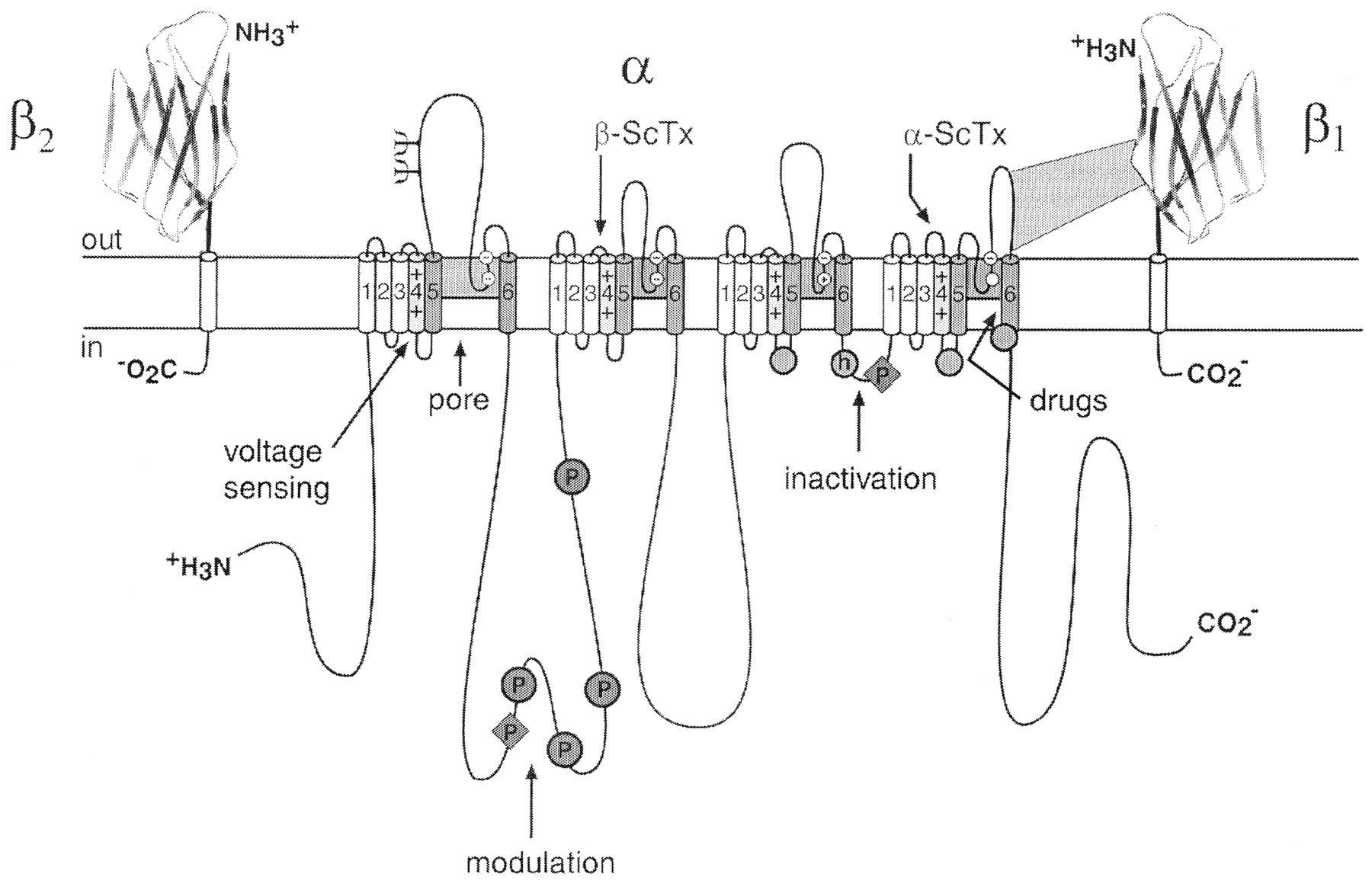
Subunit structure of the voltage-gated sodium channels. The primary structures of the subunits of the voltage-gated sodium channels are illustrated as transmembrane folding diagrams. Cylinders represent probable α-helical segments. Bold lines represent the polypeptide chains of each subunit, with length approximately proportional to the number of amino acid residues in the brain sodium channel subtypes. The extracellular domains of the β1 and β2 subunits are shown as immunoglobulin-like folds. Ψ, sites of probable N-linked glycosylation; P, sites of demonstrated protein phosphorylation by protein kinase A (circles) and protein kinase C (diamonds); EEDD, outer, and DEKA, inner rings of amino acid residues that form the ion selectivity filter and the tetrodotoxin binding site; h, inactivation particle in the inactivation gate loop. Sites of binding of α- and β-scorpion toxins, and a site of interaction between α and β1 subunits are also shown.
Sodium Channel Classification and Nomenclature
A variety of different sodium channels has been identified by electrophysiological recording, biochemical purification, and cloning (Goldin, 2001). The sodium channels are the founding members of the superfamily of ion channels that includes voltage-gated potassium and calcium channels. Unlike the different classes of potassium and calcium channels, the functional properties of the known sodium channels are relatively similar. Despite their similarity of function, the sodium channels were originally named in many different ways, with no consistent nomenclature for the various isoforms. To eliminate confusion resulting from the multiplicity of names, a standardized nomenclature was developed for voltage-gated sodium channels (Goldin et al., 2000). This nomenclature is based on that for voltage-gated potassium channels (Chandy and Gutman, 1993), which is in common use. It utilizes a numerical system to define subfamilies and subtypes based on similarities between the amino acid sequences of the channels. A comparable nomenclature has also been adopted for voltage-gated calcium channels (Ertel et al., 2000). In this nomenclature system, the name of an individual channel consists of the chemical symbol of the principal permeating ion (Na) with the principal physiological regulator (voltage) indicated as a subscript (NaV). The number following the subscript indicates the gene subfamily (currently only NaV1), and the number following the full point identifies the specific channel isoform (e.g., NaV1.1). This last number has been assigned according to the approximate order in which each gene was identified. Splice variants of each family member are identified by lowercase letters following the number (e.g., NaV1.1a).
The nine mammalian sodium channel isoforms that have been identified and functionally expressed are all greater than 50% identical in amino acid sequence in the transmembrane and extracellular domains, where the amino acid sequence is similar enough for clear alignment (Fig. 2a). For potassium channels and calcium channels, all the members of distinct subfamilies are less than 50% identical to those of other families, and there is much closer sequence identity within families (Chandy et al., 1993; Ertel et al., 2000). The sodium channel sequences vary more continuously, without defining separate families. By this criterion, all of the nine sodium channel isoforms may be considered members of one family.

Amino acid sequence similarity and phylogenetic relationships of voltage-gated sodium channel subunits. a, comparison of amino acid identity for rat sodium channels NaV1.1 through NaV1.9. The comparison was performed with Megalign in the program DNAStar (utilizing the Clustal method) for the four domains and the cytoplasmic linker connecting domains III and IV. b, phylogenetic relationships by maximum parsimony analysis of rat sodium channel sequences NaV1.1 through NaV1.9 and Nax. To perform the analysis, the amino acid sequences for all of the isoforms were aligned using Clustal W. The amino acid sequences in the alignments were then replaced with the published nucleotide sequences, and the nucleotide sequence alignments were subjected to analysis using the program PAUP*. Divergent portions of the terminal regions and the cytoplasmic loops between domains I–II and II–III were excluded from the PAUP* analysis. The tree was rooted by including the invertebrate sodium channel sequences during the generation of the tree, although these sequences are not shown in the figure.
Sodium Channel Genes
To test this hypothesis more critically, the nine sodium channel amino acid sequences were aligned and compared for relatedness using a maximum parsimony procedure that measured their evolutionary distance by calculating the number of nucleotide changes required for the change in codon at each position (Fig. 2b). The resulting phylogenetic tree is consistent the designation of these sodium channels as a single family. NaV1.1, NaV1.2, NaV1.3, and NaV1.7 are the most closely related group by this analysis. All four of these sodium channels are highly tetrodotoxin-sensitive and broadly expressed in neurons. Their genes are all located on human chromosome 2q23–24, consistent with a common evolutionary origin. NaV1.5, NaV1.8, NaV1.9 are also closely related (Fig. 2b), and their amino acid sequences are greater than 64% identical to those of the four sodium channels encoded on chromosome 2. These sodium channels are tetrodotoxin-resistant to varying degrees, due to changes in amino acid sequence at a single position in domain I, and they arehighly expresses in heart and dorsal root ganglion (DRG) neurons (Fozzard and Hanck, 1996; Catterall, 2000). Their genes are located on human chromosome 3p21–24, consistent with a common evolutionary origin. The isoforms NaV1.4, expressed primarily in skeletal muscle, and NaV1.6, expressed primarily in the CNS, are set apart from these other two closely related groups of sodium channel genes (Fig. 2b). Although their amino acid sequences are greater than 84% identical to the group of sodium channels whose genes are located on chromosome 2 (Fig. 2a), their phylogenetic relationship is much more distant when analyzed by parsimony comparison (Fig. 2b). The distant evolutionary relationship is consistent with the location of the genes encoding these two sodium channels on chromosomes 17q23–35 and 12q13, respectively. The chromosome segments carrying the sodium channel genes are paralogous segments that contain many sets of related genes, including the homeobox (HOX) gene clusters. These segments were generated by whole genome duplication events during early vertebrate evolution (Plummer and Meisler, 1999). The comparisons of amino acid sequence identity, phylogenetic relationship, and chromosomal relationship lead to the conclusion that all nine members of the sodium channel family that have been functionally expresses are members of a single family of proteins and have arisen from gene duplications and chromosomal rearrangements relatively recently in evolution. These results contrast with those for potassium channels and calcium channels, for which distinct gene families have arisen earlier in evolution and have been maintained as separate families to the present (Chandy and Gutman, 1993; Ertel et al., 2000).
In addition to these nine sodium channels that have been functionally expressed, closely related sodium channel-like proteins have been cloned from mouse, rat, and human but have not yet been functionally expressed (Nax). They are approximately 50% identical to the NaV1 subfamily of channels but more than 80% identical to each other. They have significant amino sequence differences in the voltage sensors, inactivation gate, and pore region that are critical for channel function, and have previously been proposed as a distinct subfamily (George et al., 1992). These atypical sodium channel-like proteins are expressed in heart, uterus, smooth muscle, astrocytes, and neurons in the hypothalamus and peripheral nervous system (PNS). Because of their sequence differences, it is possible that these channels are not highly sodium-selective or voltage-gated. Although these proteins have striking differences in amino acid sequence in highly conserved regions of sodium channels, their amino acid sequence is greater than 50% identical to other sodium channels. They are closely related phylogenetically to the group of sodium channels on human chromosome 2q23–24, where their gene is also located (Ertel et al., 2000). Successful functional expression of these atypical sodium channel-like proteins and identification of additional related sodium channels may provide evidence for a second sodium channel subfamily.
Three auxiliary subunits of sodium channels have been defined thus far: β1, β2, and β3 (Catterall, 2000; Isom, 2001). In the event that additional subunits are identified, we propose that the nomenclature should be comparable to that for the auxiliary subunits of calcium channels (Ertel et al., 2000).
Sodium Channel Molecular Pharmacology
All of the pharmacological agents that act on sodium channels have receptor sites on the α subunits. At least six distinct receptor sites for neurotoxins and one receptor site for local anesthetics and related drugs have been identified (Cestèle and Catterall, 2000) (Table 1). Neurotoxin receptor site 1 binds the nonpeptide pore blockers tetrodotoxin (TTX) and saxitoxin and the peptide pore blocker μ-conotoxin (Fozzard and Hanck, 1996; Terlau, 1998; Catterall, 2000). The receptor sites for these toxins are formed by amino acid residues in the pore loops and immediately on the extracellular side of the pore loops at the outer end of the pore. Neurotoxin receptor site 2 binds a family of lipid-soluble toxins including batrachotoxin, veratridine, aconitine, and grayanotoxin, which enhance activation of sodium channels. Photoaffinity labeling and mutagenesis studies implicate transmembrane segments IS6 and IVS6 in the receptor site for batrachotoxin (Cestèle and Catterall, 2000). Neurotoxin receptor site 3 binds the α-scorpion toxins and sea anemone toxins, which slow the coupling of sodium channel activation to inactivation. These peptide toxins bind to a complex receptor site that includes the S3–S4 loop at the outer end of the S4 segment in domain IV (Cestèle and Catterall, 2000). Neurotoxin receptor site 4 binds the β-scorpion toxins, which enhance activation of the channels. The receptor site for the β-scorpion toxin includes the S3–S4 loop at the extracellular end of the voltage-sensing S4 segments in domain II (Cestèle and Catterall, 2000). Neurotoxin receptor site 5 binds the complex polyether toxins breve-toxin and ciguatoxin, which are made by dinoflaggelates and cause toxic red tides in warm ocean waters (Cestèle and Catterall, 2000). Transmembrane segments IS6 and IVS5 are implicated in brevetoxin binding from photoaffinity labeling studies (Cestèle and Catterall, 2000). Neurotoxin receptor site 6 binds δ-conotoxins, which slow the rate of inactivation like the α-scorpion toxins. The location of neurotoxin receptor site 6 is unknown. Finally, the local anesthetics and related antiepileptic and antiarrhythmic drugs bind to overlapping receptor sites located in the inner cavity of the pore of the sodium channel (Catterall, 2000). Amino acid residues in the S6 segments from at least three of the four domains contribute to this complex drug receptor site, with the IVS6 segment playing the dominant role.
Receptor sites on sodium channels
This section of the compendium summarizes the major molecular, physiological, and pharmacological properties for each of the nine sodium channels that have been functionally expressed. Quantitative data are included for voltage dependence of activation and inactivation, single channel conductance, and binding of drugs and neurotoxins, focusing on those agents that are widely used and are diagnostic of channel identity and function.
Footnotes
-
↵1 This work was previously published in Catterall WA, Chandy KG, and Gutman GA, eds. (2002) The IUPHAR Compendium of Voltage-Gated Ion Channels, International Union of Pharmacology Media, Leeds, UK.
-
DOI: 10.1124/pr.55.4.7.
- The American Society for Pharmacology and Experimental Therapeutics